
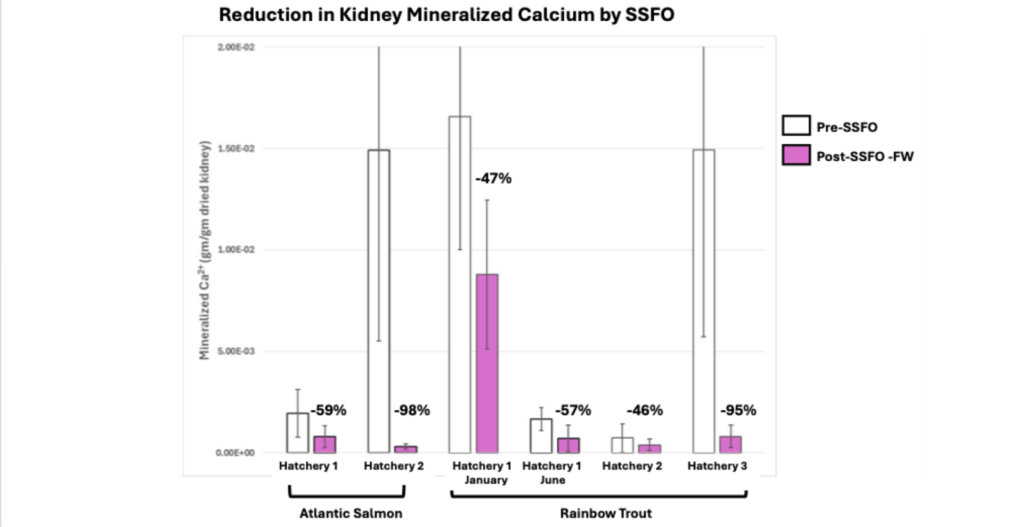
STIM, together with Norwegian and international hatcheries, has measured the amount of mineralized calcium in the kidneys before and after using SuperSmolt FeedOnly (SSFO).
The results show a reduction of 46–98 percent, depending on how severe the condition was before SuperSmolt was used. The effect has been documented in both salmon and trout in normal commercial tanks using STIM’s kidney mineral assay.
Nephrocalcinosis is the deposition of calcium and magnesium in the kidneys. It is ranked as the second most important health challenge for rainbow trout and the fourth most important for salmon in freshwater. Mortality is usually low, but the impact on growth, welfare and production performance is significant.
These deposits often start much earlier than many realize. CO₂ levels, buffering strategies, pH changes, water quality, ion stress and perhaps some feeds can trigger early mineralization already in the parr stage. The smoltification phase acts as an amplifier: when the gills, gut and kidneys are rebuilt for seawater, the physiological load increases sharply. Without a clear CaSR signal, these deposits can worsen rapidly.
CaSR is the Calsium Sensing Reseptors in the fish, crucial for the process of smoltification.
Many farmers see their fish improve after seawater transfer. This is mainly due to reduced stress including reduction in CO2 exposure, a more stable ion balance, and increased body size together with physiological changes in kidney function that favor the excretion of mineral ions rather than a tendancy to reabsorb them.
SuperSmolt FeedOnly provides a clear CaSR signal in freshwater through targeted supplementation of Ca²⁺ and Mg²⁺ combined with free tryptophan. Since kidney tissue continuously filters the fish’s blood, all of these CaSR reactive components are delivered to the tubules of the kidney so as to target CaSR proteins that are located there.
This creates three key effects before seawater transfer:
• A precise and synchronized CaSR signal that ensures controlled smoltification
• Lower ion stress and a calmer physiological state in freshwater
• A documented reduction in total and mineralized calcium in the kidneys – measured before seawater transfer
In short: Seawater can relieve stress and slow further damage from nephrocalcinosis. SSFO provides this same relief in addition to actively reducing mineralized calcium while the fish remains in freshwater.
CaSR is activated by Ca²⁺ and Mg²⁺ – not by Na⁺. Salt feed based on NaCl cannot replace the signalling required for proper remodeling of gills, gut and kidneys. Additionally, the free tryptophan in SuperSmolt FeedOnly increases CaSR sensitivity, allowing moderate mineral levels to produce a strong effect. This reduces stress and supports immune function.
Traditional methods such as visual scoring, histology and radiology detect nephrocalcinosis only after there is a significant amount of mineralized calcium deposited in the kidney. By contrast, STIM’s assay measures both soluble and mineralized calcium and magnesium, providing a quantitative early warning that can be applied to fish of a much smaller size than the tranditional methods listed above.
For farmers, this means:
• Early detection of risk
• The ability to follow development of nephrocalcinosis throughout the production cycle starting with small fish.
• A clear basis for evaluating the effect of interventions such as SSFO, water adjustments and operational changes since the STIM kidney mineral assay provides quantitative data not semi-quantitative data based on visual assessment scoring methods.
• Monitor kidney mineral levels regularly using STIM’s assay
• Start SuperSmolt well ahead of planned seawater transfer, giving the group time to smoltify correctly
• Use the assay and SSFO together to fine-tune feeding strategy and operations
This results in calmer fish, more synchronized smolt groups and stronger seawater performance.
Would you like to test this in your facility?
We can assist with sampling, data interpretation and planning of a SuperSmolt program tailored to your site.
Richard Torrissen, +47 482 00 046 / richard.torrissen@stim.no
Justin Watson, +44 7901 304375 / justin.watson@stim.uk

 STIM (NO)
 STIM (Chile)