A review of more than 320 million smolts in Chile found lower mortality, more even growth and a shorter seawater cycle in pens smoltified with SuperSmolt Feed Only.
The findings from Chilean consultancy Aquabench will be of interest beyond Chile, as producers in Scotland, Canada, Iceland and Norway face the same pressure to cut early seawater losses and shorten the marine cycle. SuperSmolt Feed Only proves to deliver just that, reliably inducing and synchronizing full smoltification without a winter photoperiod signal.
The analysis from Aquabench is possible because Chilean salmon farming has quite detailed reporting requirements, including production figures that can be linked to smoltification method. Consultancy Aquabench in Puerto Montt assessed pens stocked from January 2023 onwards in the regions Los Lagos and Aysén. The report, dated February 2026, covers 259 SuperSmolt pens at 28 sites.
Those pens were compared with two control groups: other pens in the same companies that were not smoltified with SuperSmolt, and pens across the rest of the industry. At its largest, the comparison includes more than 4,000 pens and more than 320 million smolts. The review is limited to fish stocked below 600 g.
Lower mortality, higher weight
After four months at sea, SuperSmolt pens had mortality of 1.02 percent, against 1.53 percent in same-company controls and 1.65 percent in the rest of the industry.
The same pattern held at seven months, when SuperSmolt pens still had the lowest mortality. Median weight was then 2,055 g in the SuperSmolt group, compared with 1,781 g in same-company controls and 1,874 g in the wider industry.
By harvest, cumulative mortality in SuperSmolt pens was 5.69 percent, against 8.6 percent and 8.3 percent in the two control groups.
Earlier harvest
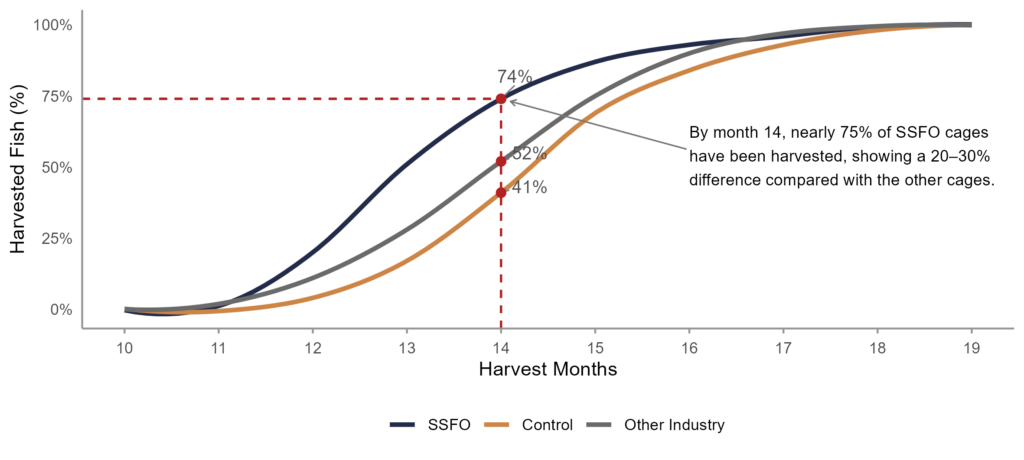
The harvest profile shows SuperSmolt fish reaching harvest sooner. Around 51 percent of the pens had been harvested in month 13 after stocking, and 74 percent in month 14. The corresponding shares were 17 percent and 41 percent in the same companies without SuperSmolt, and 28 percent and 52 percent in the rest of the industry.
Harvest weight in the SuperSmolt group was 4,975 g, roughly in line with the same-company control group and slightly below the rest of the industry. Aquabench notes that a large share of SuperSmolt pens combined a shorter time to harvest with a harvest weight above 4,500 g.
The report also describes more consistent performance between pens. In a principal component analysis (PCA), SuperSmolt pens clustered more tightly, with higher growth, better feed utilisation and lower mortality.
Useful data
-In markets outside Chile there is a lot of internal production statistics, but it is much harder to extract comparable figures for the whole industry where smoltification method is a separate, traceable variable. That is why this kind of cross-sectional analysis is more complicated at home, even though smolt quality is just as relevant, says STIM CEO Jørn Hanssen.
He argues that the Chilean reporting has real value, with regular production and health reporting to the authority Sernapesca and years of pen-level reporting from much of the industry to Aquabench.
-All together, this becomes extremely useful data that can form part of farmers’ decision-making. Here we have followed hundreds of thousands of fish through four months, seven months and all the way to harvest. We see the same pattern: SuperSmolt fish get going faster, there are fewer poor performers, and the cycle is shortened. That is exactly what good smoltification should deliver, says Hanssen.
He stresses that the report should not be read as a controlled experiment.
-Aquabench has carried out a retrospective analysis, not a randomised trial. But when SuperSmolt pens beat both neighbouring pens in the same company and the rest of the industry on mortality and time to harvest, that is a strong signal, he says.

 STIM (NO)
 STIM (Chile)